
Temperature and Particle Motion
Relate temperature to particle-scale energy and distinguish heat.
Temperature and Kinetic Model
Objective: Interpret temperature with particles and absolute scale.
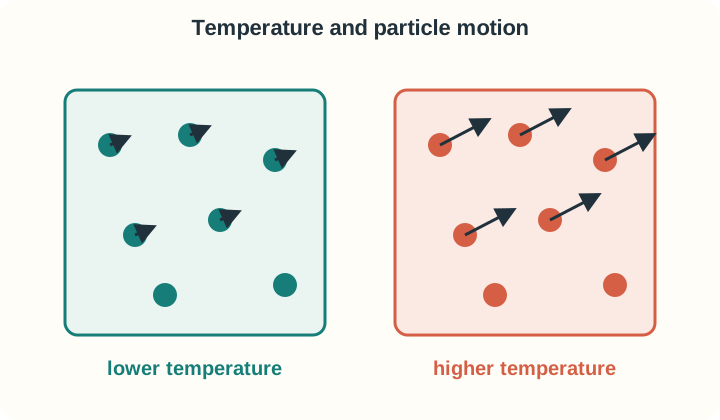
Temperature is a property related to the average kinetic energy of particles in a simple kinetic model, though molecular rotation, vibration, interactions, and collective behavior require care in detailed systems. Kelvin is the SI temperature unit, with T(K) = T(°C) + 273.15. Two objects at the same temperature can contain different total internal energies because mass, composition, and state differ. Absolute zero is 0 K, the lower limit of the thermodynamic temperature scale, not a claim that all quantum motion literally stops. Celsius temperature differences equal kelvin temperature differences. A thermometer measures a property that changes with temperature and must be calibrated.
Worked examples
Try itWhat is 25 °C in kelvin approximately?Show answer
298 K. 25 + 273.15 ≈ 298 K.
Swipe sideways to move between sections
You finished the reading!
Lock it in with a few practice questions, then move on to the next lesson.