
Heat Transfer
Compare conduction, convection, and radiation in context.
Conduction and Insulation
Objective: Explain transfer through material contact and effective insulation.
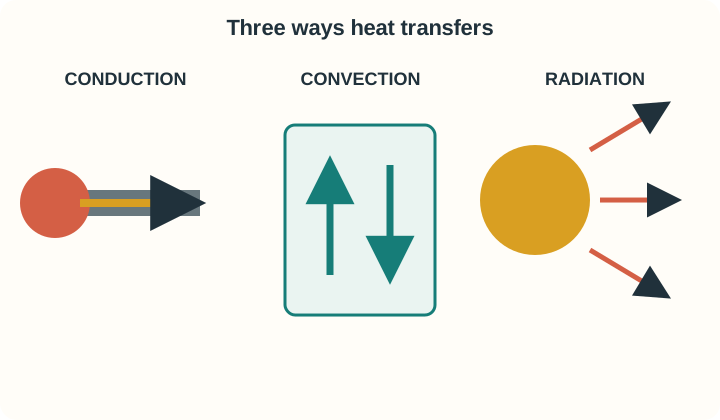
Conduction transfers energy through interactions among neighboring particles, especially within a material or across contacting surfaces. In metals, mobile electrons can contribute strongly; in other solids, lattice vibrations are important. Conductive and insulating behavior depends on material, thickness, area, and temperature difference. Insulation reduces transfer rate; it does not necessarily stop all transfer. A metal spoon warming in hot soup illustrates conduction along the spoon. A vacuum greatly reduces conduction and convection because little matter is present but can still permit radiation. Thermal conductivity is a material parameter, not a promise that every object of that material transfers at the same rate.
Worked examples
Try itA metal spoon warms from its immersed end toward its handle. Which mechanism dominates along the spoon?Show answer
Conduction. Neighboring particle and electron interactions transfer energy.
Swipe sideways to move between sections
You finished the reading!
Lock it in with a few practice questions, then move on to the next lesson.