
Valence Electrons and Bonding Models
Explain why atoms bond using electron and energy models.
Valence Electrons and Stability
Objective: Use outer-electron patterns without treating the octet as an absolute law.
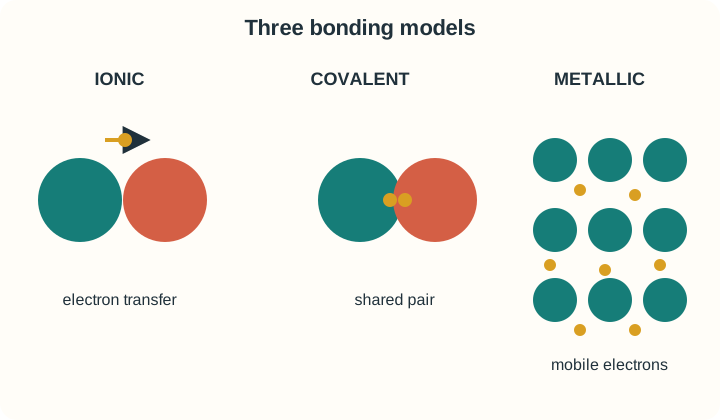
Valence electrons are electrons involved most directly in bonding in introductory main-group models. Interacting atoms can form lower-energy arrangements through electron transfer, sharing, or delocalization under suitable conditions; a bond forms when the combined system is energetically favorable relative to separated constituents. The octet rule is a useful heuristic for many main-group compounds, not a universal mechanism or proof that every atom literally “wants” eight electrons. Hydrogen commonly follows a two-electron pattern, while boron, transition elements, and expanded-valence descriptions require exceptions. Lewis symbols depict valence electrons, not exact three-dimensional electron probability distributions. Bonding claims need a stated substance and context.
Worked examples
Try itWhich electrons are most central to introductory bonding models?Show answer
Valence electrons. Outer electrons participate most in many bonds.
Swipe sideways to move between sections
You finished the reading!
Lock it in with a few practice questions, then move on to the next lesson.