
Reflection and Refraction
Apply ray models at boundaries and explain color.
Law of Reflection
Objective: Use incident and reflected angles relative to a normal.
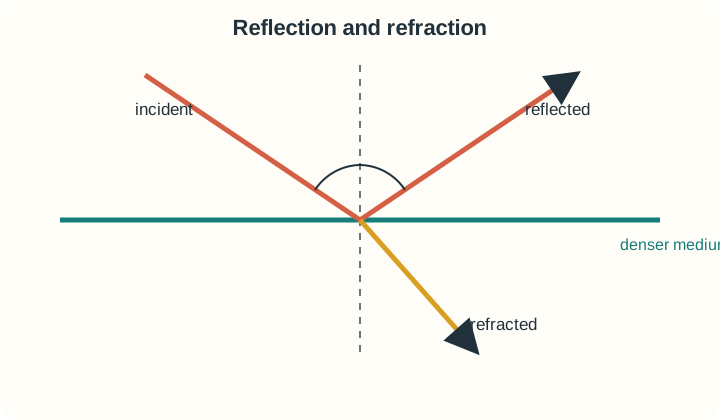
In a ray model of specular reflection from a smooth surface, angle of incidence equals angle of reflection when both are measured from the surface normal. A ray striking at 30° from the normal reflects at 30° on the other side of the normal. Diffuse reflection from a rough surface still follows local reflection at small facets but scatters rays in many directions. A mirror’s image is formed by the geometry of reflected rays, not by light emerging from behind the mirror. Ray diagrams are useful when wavelength is small compared with structures; wave behavior becomes important in other regimes. Distinguish angles from the normal versus from the surface.
Worked examples
Try itA ray strikes a mirror at 30° from the normal. What is reflected angle from the normal?Show answer
30°. Angles match about the normal.
Swipe sideways to move between sections
You finished the reading!
Lock it in with a few practice questions, then move on to the next lesson.