
Measurement, Units, and Uncertainty
Calculate with units and interpret measurement limits.
SI Units and Conversions
Objective: Use base and derived units and factor-of-ten prefixes.
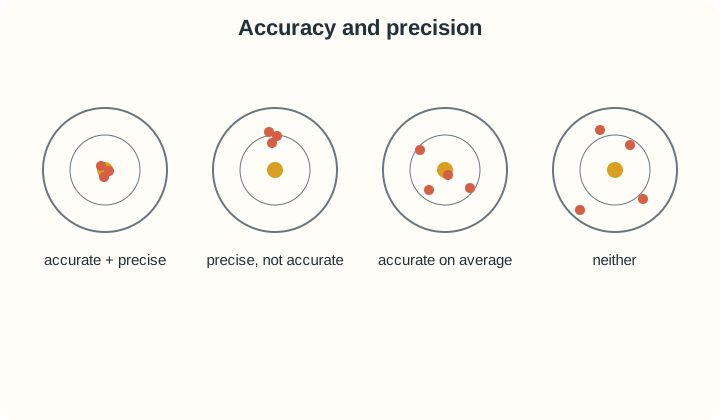
The International System of Units (SI) provides shared measurement conventions. Length is measured in meters (m), mass in kilograms (kg), and time in seconds (s); speed has derived unit m/s, acceleration m/s², and force newtons (N = kg·m/s²). Prefixes scale a unit: kilo- means 10³ and centi- means 10⁻². Dimensional analysis multiplies by conversion factors equal to one, preserving the measured quantity. For instance, 2.5 km = 2.5 × 1000 m = 2500 m. A number without a unit can be ambiguous. A converted value does not gain accuracy merely by adding digits.
Worked examples
Try itHow many meters are in 3.2 kilometers?Show answer
3200 m. Multiply by 1000 m per kilometer.
Swipe sideways to move between sections
You finished the reading!
Lock it in with a few practice questions, then move on to the next lesson.