
Conservation of Energy
Use system boundaries to trace mechanical and thermal changes.
Mechanical Energy in Ideal Motion
Objective: Apply K + U conservation when nonconservative transfer is negligible.
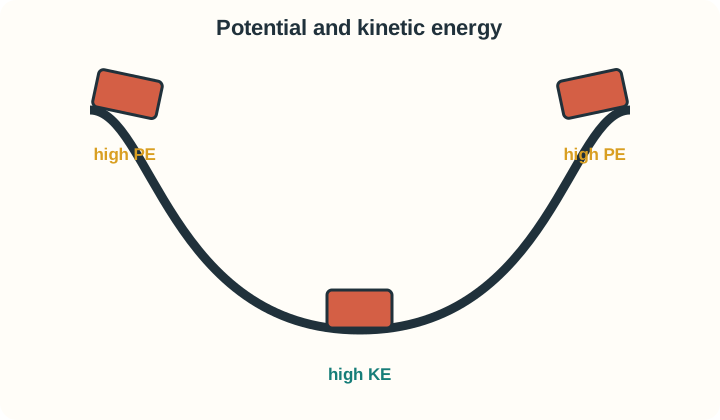
Mechanical energy is the sum of selected kinetic and potential energies, commonly E_mech = K + U_g + U_s. If a system experiences negligible friction, drag, and external work, its mechanical energy can be approximately constant. For a falling object, a decrease in gravitational potential energy accompanies an increase in kinetic energy. Starting at rest 5 m above a chosen zero level, the ideal model gives K = mgh immediately before reaching that level, provided other stores are negligible. The total energy of an appropriately enlarged system remains conserved even when mechanical energy changes. The assumptions and reference level must be stated.
Worked examples
Try itIn an ideal fall from rest with negligible drag, what happens to U_g as K rises?Show answer
U_g decreases. Potential energy transfers into kinetic energy.
Swipe sideways to move between sections
You finished the reading!
Lock it in with a few practice questions, then move on to the next lesson.